Yet Remote Control Manufactory specialized in wireless remote control with 20 years of experience.
Language
Yet Remote Control Manufactory specialized in wireless remote control with 20 years of experience.
Smart Rolling Shutter Controller: Applications and Expansion with Tuya App Integration YET863WTR
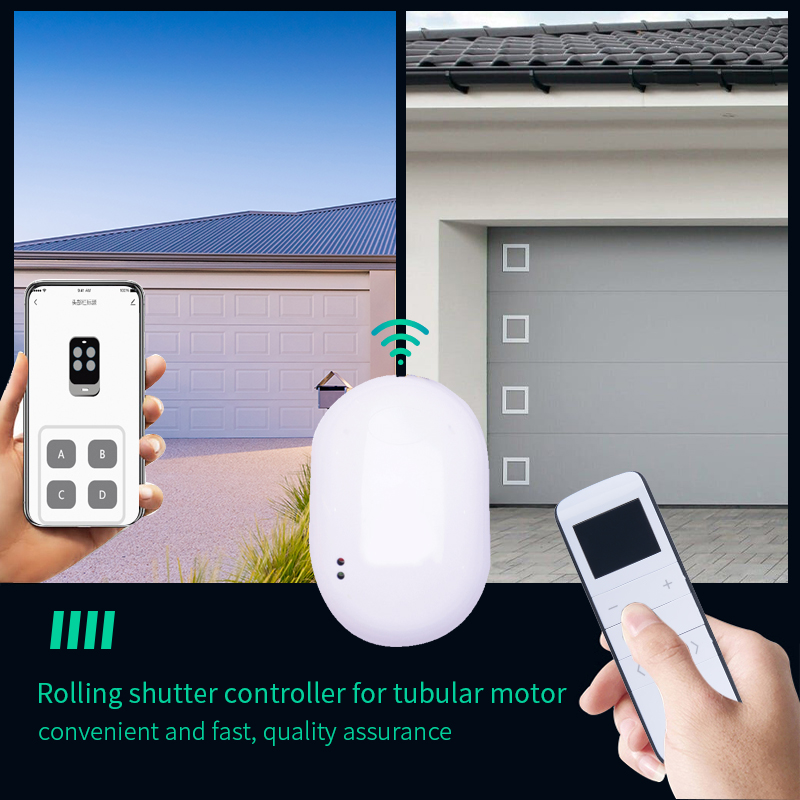
Rolling shutter controllers, particularly those featuring learning code (1527), dual RF (433.92MHz) and Wi-Fi (2.4GHz) connectivity, external switch support, and power management buttons, have revolutionized automated shading solutions. These controllers enable seamless operation of tubular motors via smartphone apps, remote controls, and external switches, making them ideal for residential, commercial, and industrial applications.
This article explores the diverse use cases of such smart rolling shutter controllers and discusses potential expansions in automation, security, and energy efficiency.
Residential Applications
Smart Home Integration
With Wi-Fi (2.4GHz) and RF (433.92MHz) connectivity, users can control their roller shutters via smartphone apps, some voice assistants, or remote controls. The learning code (1527) feature ensures compatibility with existing RF remotes, eliminating the need for additional hubs.
Convenience: Open or close shutters remotely before arriving home.
Security: Schedule automatic closing at night or when away.
Energy Efficiency: Adjust shutters based on sunlight to regulate indoor temperature.
Expansion:
- Integration with weather APIs to auto-adjust shutters based on sunlight, wind, or rain.
Geofencing to trigger shutter movements when users leave or approach home.
1.2Child and Pet SafetyManual rolling shutters can pose risks to children or pets. A smart controller with an external switch allows safe operation without direct handling of the shutter mechanism.
Expansion:
Obstacle detection(via additional sensors) to prevent accidents if objects block the shutter.
2.Commercial & Office Applications
2.1 Automated Storefronts & Restaurants
Retail stores and cafes benefit from remotely controlled shutters, improving security and energy management.
Opening/Closing Automation: Set schedules for business hours.
Emergency Lockdown: Trigger immediate closure via app in case of security threats.
Expansion:
Integration with POS systems to automatically open shutters at store opening time.
2.2 Smart Office Blinds for Energy Savings
Offices with large windows can optimize natural light while reducing HVAC costs.
Sunlight Tracking: Adjust shutters based on daylight intensity.
Remote Management: Facility managers can control multiple shutters via a single app.
Expansion:
AI-based light optimization to balance natural and artificial lighting.
3.Industrial & Security Applications
3.1 Warehouse & Factory Shutter Control
Industrial facilities require robust, remote-controlled shutters for ventilation, security, and access control.
RF + Wi-Fi Redundancy: Ensures operation even if Wi-Fi is unstable.
External Switch Support: Allows manual override in emergencies.
Expansion:
Integration with fire alarms to automatically open shutters for ventilation during emergencies.
3.2 High-Security Facilities
Government buildings, data centers, and banks need tamper-proof shutter control.
Encrypted RF/Wi-Fi signals prevent unauthorized access.
Power ON/OFF & Learning Button: Allows quick reset if security is compromised.
Expansion:
Biometric or RFID-based authentication for shutter operation.
4.Future Expansion & Smart City Integration
4.1 Smart Building Management
Centralized control of multiple shutters in apartment complexes or commercial hubs.
Energy consumption analytics to optimize shading schedules.
4.2 IoT & Cloud-Based Automation
Cloud-based scheduling for large-scale deployments.
Predictive maintenance alerts based on motor performance data.
4.3 Integration with Smart Grids
Demand-response systems where shutters adjust automatically to reduce peak energy loads.
Conclusion
Smart rolling shutter controllers with learning code (1527), dual RF/Wi-Fi connectivity, external switch support, and power management offer versatile automation for homes, businesses, and industries. Future expansions—such as AI-driven light optimization, IoT cloud integration, and smart city applications—will further enhance their role in security, energy efficiency, and convenience.
By leveraging app-based control, automation schedules, and third-party integrations, these controllers are paving the way for next-generation smart shading solutions.