Yet Remote Control Manufactory specialized in wireless remote control with 20 years of experience.
Language
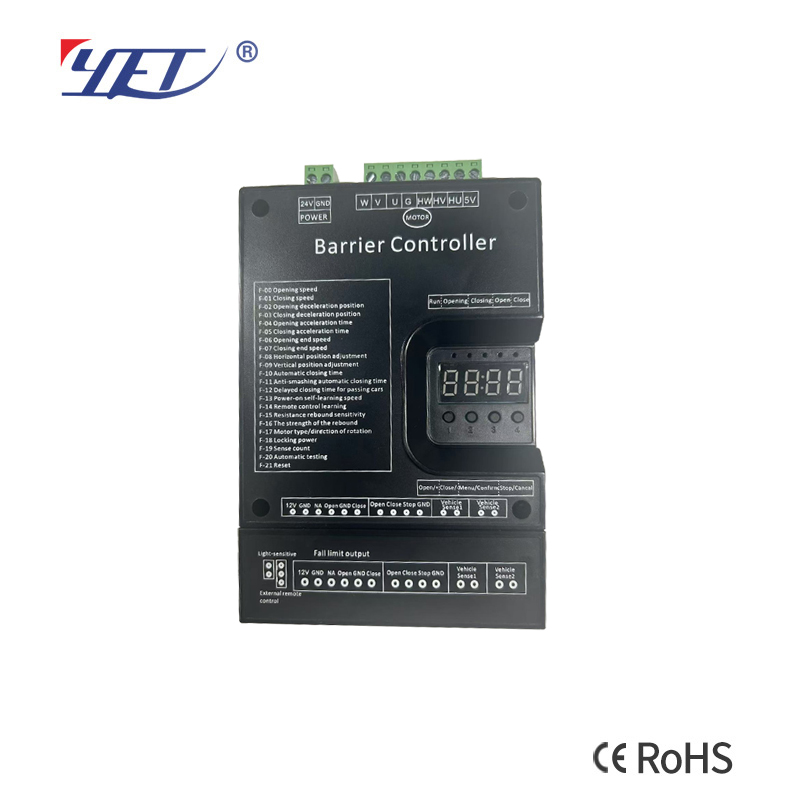
As a core component of intelligent transportation and security systems, barrier controllers are widely used in parking lots, residential areas, industrial parks and other scenarios. Their technological development and application trends are constantly evolving with the advancement of technologies such as intelligence and the Internet of Things.
I. Main Application Scenarios
1. Parking Lot Management
Commercial/Residential Parking Lots: Implement license plate recognition, automatic billing, and unmanned operation to improve traffic efficiency.
Street Parking: Manage temporary parking spaces using geomagnetic or video detection.
Storage Garages: Link with elevators to optimize vehicle access.
2. Smart Communities and Parking Facilities
Ensure internal security in schools, hospitals, and government offices by controlling barriers using Bluetooth, an app, or facial recognition.
3. Highways and Transportation Hubs
ETC contactless payment and emergency lane management reduce congestion.
4. Logistics and Warehousing
Automatically manage freight vehicle access and integration with WMS (Warehouse Management System).
5. Special Locations
Vehicle access management in temporary locations such as scenic spots and construction sites.
II. Technology Development Trends
1. Intelligent and AI Integration
License Plate Recognition Upgrade: Supports blurred license plates and unlicensed vehicles (verified via QR code or app).
Behavior Analysis: Detects pedestrians or vehicles illegally entering a gate and triggers an alarm.
2. Internet of Things (IoT) Integration
Remote Monitoring and Operations: View device status in real time through the cloud platform and predict faults (such as motor life warnings).
Multi-Device Interoperability: Works collaboratively with lighting, surveillance cameras, charging stations, and more.
3. Contactless Payment and Multimodal Verification
Supports ETC, app payment, and credit debit (such as password-free payment through Alipay/WeChat binding).
Biometric recognition (face recognition, fingerprint recognition) combined with RFID technology enhances security.
4. Modular and Energy-Saving Design
Solar power supply and low-power standby mode adapt to outdoor environments without electricity.
Modular structure facilitates quick component replacement (such as control boards and motors).
5. Edge Computing and Data Value Mining
Localized data processing reduces cloud reliance and improves response speed.
Traffic flow data analysis assists in parking resource planning and traffic scheduling.
6. Adapting to New Energy Demand
Design dedicated barriers for electric vehicle charging parking lots, compatible with charging station management.
III. Future Outlook
Block controllers will gradually evolve from simple vehicle control devices to "intelligent nodes," integrating into vehicle-to-everything (V2X) systems. For example, they will:
Communicate with autonomous vehicles to enable gate-free passage;
Serve as urban traffic sensing terminals and contribute to congestion management.
With the maturity of 5G and digital twin technologies, the real-time performance and scenario-adaptability of barrier systems will reach new heights.